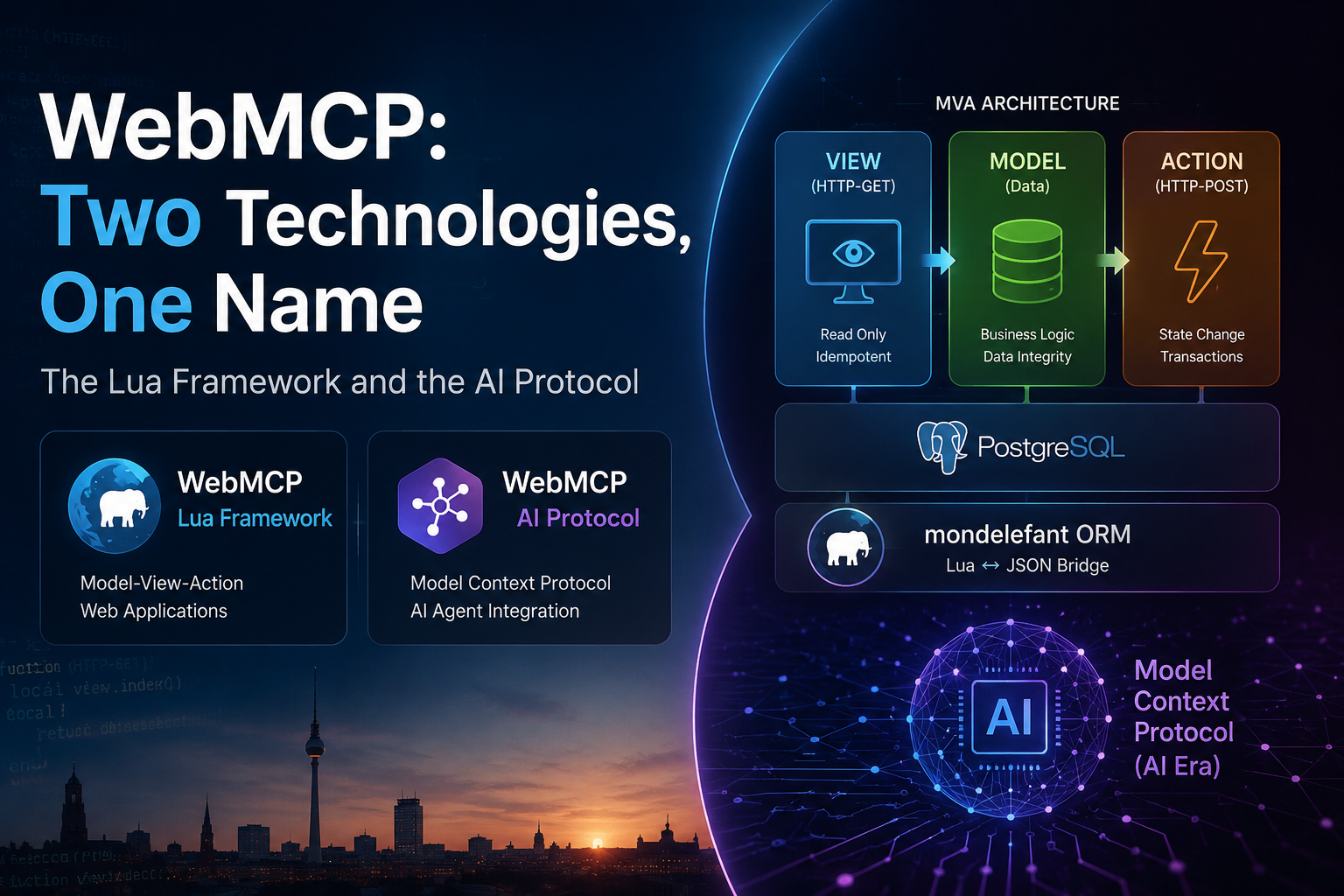
The evolution of web application frameworks is largely characterized by a continuous, iterative search for optimal software design patterns that balance developer ergonomics, execution speed, and architectural rigidity. Among the myriad of structural philosophies that have emerged over the past two decades, the classic Model-View-Controller (MVC) paradigm has historically dominated the landscape of interactive web systems. However, alternative paradigms have been meticulously engineered to address the specific idiosyncrasies and stateless nature of Hypertext Transfer Protocol (HTTP) communication. One of the most sophisticated deviations from the MVC standard is the WebMCP framework, architected by the Public Software Group e.V., a technology collective based in Berlin, Germany1.
WebMCP is a highly specialized, performance-oriented web application framework authored in a hybrid technology stack utilizing the Lua programming language for business logic and C for performance-critical low-level operations1. Designed explicitly to enforce the Model-View-Action (MVA) architectural pattern, WebMCP fundamentally rethinks how user interactions, database transactions, and user interface rendering are structurally segregated within a web application's lifecycle1. While the specific acronym "WebMCP" has recently been adopted within the modern artificial intelligence community to describe the "Model Context Protocol" for exposing web interfaces to autonomous agents5, the Lua-based web framework (first released in 2009) is the historically older use of the name. In 2026, however, the AI-protocol meaning is by far the more widely used one.
This research report provides an exhaustive, multi-layered analysis of the WebMCP ecosystem. The examination rigorously deconstructs the theoretical underpinnings of the MVA pattern, the deep systems integration of the Moonbridge Network Server for Lua Applications, the precise transactional mechanics of the mondelefant Object-Relational Mapping (ORM) system, and the deployment of WebMCP in its flagship enterprise application: the LiquidFeedback digital democracy platform. Furthermore, to ensure absolute completeness and resolve industry nomenclature collisions, this report will systematically disambiguate and analyze the modern AI-driven iterations of the WebMCP standard, identifying the profound philosophical parallels between the two distinct software engineering technologies.
The Model-View-Action (MVA) Architectural Paradigm
To comprehend the core utility and structural necessity of WebMCP, one must first analyze the inherent limitations of the traditional Model-View-Controller architecture when applied strictly to web environments. In a standard MVC web framework, a central controller entity receives an incoming HTTP request, mutates the state of the model, and selects a specific view to render the output response. This structural design frequently leads to the anti-pattern known as "fat controllers," where business logic, dynamic routing, and complex HTTP state management become inextricably entangled. Furthermore, MVC frameworks often blur the lines between safe, idempotent read operations and state-mutating write operations, leaving the responsibility of preventing data corruption entirely to the discipline of the individual developer.
WebMCP discards the generalized controller entity entirely in favor of the strict Model-View-Action (MVA) concept1. The MVA pattern aligns the software architecture directly with the semantic intentions of the HTTP protocol, creating an impenetrable structural dichotomy between data retrieval and data mutation.
The View Layer: Enforcing HTTP Idempotency
Within the WebMCP architecture, the View layer is exclusively and inflexibly responsible for handling HTTP-GET requests1. The architectural philosophy driving this design dictates that a View must never, under any circumstances, alter the state of the application or the persistent database. When an HTTP-GET request is dispatched to the server by a client browser or API consumer, the WebMCP internal routing engine maps the requested Uniform Resource Identifier (URI) directly to a specific View script.
The View processes the incoming request parameters, executes read-only query selectors against the PostgreSQL database through the Model layer, and subsequently renders the output—typically Hypertext Markup Language (HTML), Extensible Markup Language (XML), or JavaScript Object Notation (JSON)—back to the client1. By enforcing idempotency at the fundamental framework level, developers are physically prevented from inadvertently writing logic that mutates database state during a simple page refresh or during a web crawler's automated indexing operation.
To facilitate internal encapsulation and logical separation of concerns, WebMCP implements a highly effective routing security mechanism where Views prefixed with an underscore character (_) are treated as strictly private1. These private views cannot be invoked directly via external URL routing, allowing software engineers to build modular, reusable View components and partials that are safely hidden from the public routing table, yet accessible for internal server-side composition1.
The Action Layer: State Mutation and Transactional Flow Control
Conversely, all HTTP-POST requests are entirely and automatically routed to the Action layer1. Actions represent the definitive transaction boundaries of the web application. An Action script receives untrusted user input, validates the data payload, and performs potentially destructive write operations to the database via the Model layer1.
Crucially, an Action in the traditional WebMCP execution flow does not render a user interface or return HTML directly to the client. Instead, upon the completion of its database transactions, the Action evaluates whether the operation was a success or a failure and issues an explicit HTTP redirect (such as a 303 See Other or 301 Moved Permanently) to an appropriate View1. This framework-level enforcement of the Post/Redirect/Get (PRG) pattern eliminates the classic "double submit" problem, where a user refreshes a web page immediately after submitting a POST request and inadvertently duplicates a financial transaction or database entry.
While the strict PRG pattern serves as the default, robust behavior, the maturation of WebMCP has allowed for necessary architectural flexibility. In advanced use cases—such as responding to asynchronous JavaScript (AJAX) requests or serving highly specific RESTful Application Programming Interface (API) calls—Actions can intentionally bypass the redirect phase and return content directly by explicitly defining a custom layout directive1. Furthermore, the framework provides native, built-in support for HTTP OPTIONS requests, which is essential for managing Cross-Origin Resource Sharing (CORS) preflight checks in modern decoupled, headless client-server architectures1.
The Model Layer: Relational Database Abstraction
The Model layer serves as the unified, object-oriented interface between the application's business logic and the persistent data storage. In WebMCP, this layer is manifested through an advanced Object-Relational Mapping (ORM) system that translates relational database tables into mutable Lua objects1. The Model ensures that all Views and Actions interact with the database through a consistent, type-safe API, abstracting away raw SQL string concatenation while rigorously maintaining the ability to execute highly optimized, database-specific operational queries when necessary.
| Architectural Feature | Traditional MVC Frameworks | WebMCP (MVA Paradigm) |
|---|---|---|
| HTTP-GET Handling | Controller intercepts, routes to View | Handled directly by the designated View |
| HTTP-POST Handling | Controller updates Model, selects View to render | Handled exclusively by Action, redirects to View |
| Idempotency Enforcement | Relies entirely on developer discipline and review | Enforced structurally by the framework's routing layer |
| Double-Submit Prevention | Requires manual PRG implementation per controller | Native, default behavior of the Action layer execution |
| State Mutation Boundaries | Controllers frequently mutate state inadvertently | Actions mutate state exclusively and intentionally |
Architectural Foundations and the Dependency Matrix
The execution speed, concurrency model, and deployment strategy of WebMCP are dictated by its foundational dependencies. The framework operates on a highly specific technology stack designed for maximum throughput and minimal operational overhead, prioritizing deep integration over broad, generalized compatibility.
Lua and C Interoperability
WebMCP is written in a combination of Lua and C1. Lua is globally renowned within the software engineering community for its minimalistic memory footprint, exceptionally high execution speed, and powerful C Application Programming Interface (API), making it an ideal embeddable scripting language for infrastructure-level software and high-performance routing engines.
Historically, early versions of the framework supported older language iterations, but WebMCP strictly requires modern iterations of the language, specifically Lua version 5.2 or 5.3, having officially and permanently dropped compatibility with Lua 5.1 in the landmark release of WebMCP version 2.0.0 (released March 24, 2015)1. This transition was not merely a syntactic update; it was a strategic architectural decision driven by fundamental changes in how Lua handles memory management, variable scoping, and garbage collection.
Specifically, the framework leverages new core language features—such as native Lua uservalues—to bridge the gap between complex C data structures and Lua's dynamic execution environment1. This synergy allows computationally expensive operations, such as string parsing, cryptographic hashing, and database serialization, to be executed at native C execution speeds, while the application's business logic remains highly malleable, hot-reloadable, and expressive within Lua. The framework's Makefile.options file was specifically updated to default to Lua 5.3 paths, ensuring seamless compilation in modern Linux and BSD environments1.
The Moonbridge Network Server Integration
Historically, scripting-based web frameworks relied on massive, external web servers (such as Apache HTTP Server or Lighttpd) communicating via the Common Gateway Interface (CGI) or FastCGI protocols to spawn and execute application scripts per request. Early versions of WebMCP (version 1.x) operated on this traditional, albeit slow, paradigm. However, the architecture underwent a profound paradigm shift with the release of WebMCP 2.0, which mandated the integration of the Moonbridge Network Server for Lua Applications (requiring version 1.0.1 or higher, with later deployments utilizing Moonbridge 1.1.3)1.
Developed concurrently by the Public Software Group, Moonbridge replaces CGI invocation entirely1. Instead of a third-party server spawning a new, heavy operating system process or thread for every incoming HTTP request, WebMCP utilizes Moonbridge to open a standalone Transmission Control Protocol (TCP) port that natively and directly responds to HTTP/1.1 requests1. This architecture enables native support for persistent HTTP connections (keep-alive), drastically reducing the latency associated with the TCP handshake overhead on sequential user requests1.
The operational mechanics of Moonbridge rely heavily on a sophisticated pre-forking architecture augmented by Lua coroutines. The server employs pre-fork and post-fork initializers, allowing complex background tasks and database connection pools to be configured directly within the application's configuration files before the lightweight worker processes are spawned1. This architecture provides several distinct, highly advantageous characteristics:
- Memory Efficiency and Copy-on-Write: By utilizing a pre-fork model, the host operating system's copy-on-write (CoW) semantics ensure that the memory footprint of the Lua interpreter and the framework's core C libraries are shared optimally across all active worker processes.
- Bytecode Caching: WebMCP intercepts and caches the compiled Lua bytecode of both the framework internals and the developer's application code entirely in memory1. This completely eradicates the need to load, read, and parse source files from the physical filesystem on a per-request basis, shifting the performance bottleneck strictly to the database query execution and CPU processing rather than disk input/output (I/O).
- Concurrency via Coroutines: The Moonbridge server utilizes Lua's native coroutines to manage concurrent script executions. If an initializer or a worker encounters a blocking operation (such as waiting on a network socket or a database response), the coroutine yields execution, allowing the system to process other concurrent requests simultaneously1. The framework meticulously captures the stack traceback of these initializers or finalizers in the event of an error, ensuring robust debugging capabilities despite the highly asynchronous execution flow1. Database connections, critically, can be established inside post-fork initializers using the
execute.inner()call to prevent socket sharing violations across forked processes1.
PostgreSQL: The Exclusive Database Engine Paradigm
Unlike generic, mass-market ORMs (such as Active Record or Hibernate) that attempt to support MySQL, SQLite, Oracle, and SQL Server through lowest-common-denominator, highly abstracted SQL generation, WebMCP made the uncompromising architectural decision to support only the PostgreSQL Database Server1. Passing the engine=postgresql argument to the connection functions was eventually explicitly deprecated because PostgreSQL became the undisputed, sole supported backend for the framework1.
This exclusivity is a defining feature of the framework. It allows WebMCP to leverage highly advanced, proprietary features of PostgreSQL without abstracting them away into generic, slow equivalents. The framework tightly integrates with PostgreSQL's specific implementations of transaction isolation, row-level locking, JSON data types, and recursive query structures. To compile the database adapter seamlessly, the WebMCP build process intelligently utilizes the pg_config binary provided by PostgreSQL by default during the make execution1.
The mondelefant ORM System: Advanced Relational Mechanics
The Model layer of WebMCP is powered entirely by the mondelefant library, an Object-Relational Mapping system written primarily in C to maximize performance, with class methods mapped directly to Lua for developer usability1. The continuous evolution of mondelefant represents some of the most complex software engineering within the WebMCP ecosystem, particularly regarding garbage collection memory management and SQL query optimization.
Memory Management and the Transition to Uservalues
A critical leap in the framework's long-term stability and performance occurred when the C implementation of mondelefant abandoned the use of ephemeron (or weak-key) tables—a memory management technique heavily relied upon in Lua 5.11. While ephemeron tables are theoretically useful for mapping C pointers to Lua objects without preventing garbage collection, they introduce significant computational overhead during the garbage collection cycle. In highly concurrent web environments, this overhead frequently led to potential out-of-memory (OOM) errors or severe emergency garbage collection pauses under heavy user load.
In WebMCP 2.x, the library fundamentally transitioned to using Lua uservalues (a feature introduced natively in Lua 5.2)1. Uservalues allow arbitrary Lua values to be directly associated with full userdata (the C structures representing database connections, statement handles, or query results). This direct, low-level association significantly streamlines the memory allocation process, resulting in vastly improved, predictable behavior during high-throughput scenarios and effectively mitigating the systemic risks of emergency garbage collection1.
Advanced Relational Algebra and Query Security
The mondelefant ORM is mathematically engineered to prevent common SQL abstraction flaws while providing native access to complex relational algebra.
- Automatic Parentheses Binding: The ORM automatically encloses all
WHEREandHAVINGconditional expressions within parentheses during raw SQL query construction. This seemingly simple structural feature systematically eradicates insidious, difficult-to-trace bugs related to SQL operator precedence (e.g., mixingANDandORoperators dynamically without proper isolation)1. - Recursive Query Traversal: Modern database architectures often require traversing hierarchical, tree-based, or graph-based data. mondelefant provides the explicit
:add_with(...)method, allowing developers to natively constructWITH RECURSIVECommon Table Expressions (CTEs) within the Lua interface, pushing the computational graph traversal to the database engine rather than performing iteration in the application layer1. - Concurrency Control and Locking: To maintain strict ACID (Atomicity, Consistency, Isolation, Durability) compliance in highly concurrent web applications, the ORM supports row-based locking for database selectors directly via the Lua API, preventing race conditions during financial or democratic voting transactions1. Furthermore,
UPSERToperations (utilizingINSERT ... ON CONFLICTmechanics) were integrated natively into the library to handle concurrent data insertion elegantly1. - Asynchronous Database Notifications: The library exposes PostgreSQL's powerful
LISTEN/NOTIFYpub/sub system through the:wait(...)and:try_wait(...)methods, allowing the web framework to react to database events asynchronously without resorting to aggressive, resource-heavy polling1. - Performance Caching: The ORM employs a highly optimized
:count()method, which is designed to cache and subsequently retrieve the theoretical total number of rows that would have been returned by an:exec()execution, minimizing redundant aggregate queries1.
The JSON Bridge: Marrying SQL and Document Stores
One of the most profound architectural shifts in modern database theory is the integration of unstructured JSON document stores within rigid relational database environments. PostgreSQL's introduction of the jsonb data type revolutionized this space by allowing indexed, queryable document storage, and WebMCP adapted mondelefant to exploit it fully.
The ORM provides deep, seamless support for mutable data types, explicitly focusing on mutable JSON structures1. Developers can store primary keys as JSON fields if necessary1. More importantly, WebMCP introduces the .document_column configuration directive. When a software engineer sets a table column as a .document_column, the ORM treats the database row not just as a set of flat relational columns, but as a direct gateway to a nested JSON object1.
This architectural bridge allows Lua code to access and mutate the JSON document directly through standard Lua object notation. To maintain backward compatibility and allow raw relational column access simultaneously, the framework exposes the ._col attribute. Utilizing ._col forces the ORM to bypass the JSON document logic and access the raw PostgreSQL relational columns directly, providing the ultimate flexibility between schema-less and schema-strict data1.
Furthermore, the internal JSON parser was heavily optimized at the C-level to improve the encoding and decoding of JSON numbers. It includes complex logic to carefully round floating-point numbers if re-importing them as double-precision integers does not induce a catastrophic loss of precision. It also automatically decodes certain JSON numbers as native Lua 5.3 integers if the interpreter supports it1.
Internal Routing, Execution, and State Management
Beyond its sophisticated database interactions, WebMCP provides a comprehensive suite of tools for managing HTTP state, debugging application flow, and enforcing environmental configuration security. The framework's internal architecture is meticulously designed to minimize global state pollution while maximizing request-level flexibility.
Request Lifecycle and the app State Isolation
Because WebMCP utilizes the Moonbridge server to maintain a persistent Lua runtime state across thousands of multiple requests, managing variable scope is absolutely critical. A naive implementation could easily leak highly sensitive data from one user's HTTP request into another user's subsequent request. To prevent this security vulnerability, WebMCP strictly prohibits the accidental setting of global variables in the core Lua environment1.
Instead, the framework reuses a highly controlled application state to serve multiple requests safely. Variables that require a request-level lifetime—such as the authenticated user's session token, parsed URL query parameters, or temporary rendering cache buffers—must be explicitly attached to the global app table1. This table is systematically wiped, destroyed, or re-initialized per request, ensuring total data isolation between concurrent HTTP connections handled by the identical Lua worker process. To facilitate request-based initialization, functions such as request.for_each(...), request.configure(...), and request.initialize() were introduced to register execution logic that runs cleanly at the beginning of each HTTP lifecycle1.
Configuration Mutability and Routing Mechanisms
WebMCP streamlines the configuration of web applications by moving away from hardcoded filesystem paths and relying on immutable contextual constants. Legacy API functions used for path resolution in version 1.x, such as request.get_config(), request.get_app_basepath(), and request.get_app_name(), were entirely deprecated and replaced by strict framework constants: WEBMCP_CONFIG_NAMES, WEBMCP_BASE_PATH, and WEBMCP_APP_NAME1. This immutable approach to configuration ensures that routing directives cannot be inadvertently overwritten during runtime by malicious input or developer error.
Routing within WebMCP is highly self-contained and powerful. The framework supports URL parsing directly internally, effectively simplifying the configuration required on front-facing reverse proxies (such as Nginx or HAProxy) because the application itself understands its routing context natively1. It includes advanced URL manipulation capabilities, such as native support for URL fragments (anchors #) for redirecting, routing, and pagination links, allowing robust deep-linking within single-page application (SPA) paradigms1.
Furthermore, WebMCP automatically calculates string truncation based on Unicode codepoints rather than byte length, which is a crucial mathematical distinction for internationalized applications handling complex multi-byte character sets (such as Arabic or CJK ideographs)1. To handle external dependencies seamlessly, WebMCP provides functions like request.redirect{...}, which was updated to support an include_tempstore parameter (defaulting to false for external URLs) to securely manage session state during cross-domain redirects1. Support for relative URIs in 301/303 HTTP redirects is also natively built into the routing engine in strict accordance with RFC 7231 specifications1.
Trace Debugging, Bug Resolutions, and Ancillary Libraries
A hallmark of enterprise-grade web frameworks is their ability to deeply introspect their own performance and securely recover from faults. WebMCP includes an exceptionally powerful internal trace system. Unless explicitly disabled via configuration, the framework automatically enables a high-resolution SQL tracer that tracks the exact microsecond execution time of every single SQL statement dispatched to PostgreSQL1.
The debug output goes far beyond simple query logging; it partitions the request lifecycle into logical execution sections and outputs detailed metrics regarding Lua CPU execution time, database network wait time, and overall system real-time for every designated segment1. This allows developers to instantly identify whether system latency is stemming from Lua algorithmic bottlenecks or unoptimized database indexing. Functions such as trace.debug_traceback(), trace.debug_table(...), and trace.disable() give developers granular programmatic control over this telemetry data1.
The maturation of the framework's C-bindings is highly evident in its rigorous bug resolution history. For example, the Public Software Group patched a critical segmentation fault within the json.export(...) routine—a fix with profound security implications, as memory corruption during data serialization is a frequent vector for remote code execution vulnerabilities1. Similarly, they resolved a complex bug in the error handling of the extos.pfilter(...) function, which was caused by a noncompliant strerror_r() implementation triggered when _GNU_SOURCE was set during compile time1. Compatibility anomalies in the multirand library were also addressed to ensure Lua 5.3 compatibility if the interpreter was compiled without LUA_COMPAT_5_2 (utilizing luaL_checkinteger instead of luaL_checkint)1.
In addition to core routing and debugging, WebMCP ships with highly specialized internal utility libraries. The moonhash library provides native Secure Hash Algorithm 3 (SHA-3) cryptographic hashing capabilities directly within the Lua environment, eliminating the need for external shell calls for data integrity verification1. The network stack includes configurable mail interfaces via net.configure_mail{...}, allowing developers to bypass the default /usr/sbin/sendmail binary in favor of alternative Mail Transfer Agents (MTAs) while providing native support for setting raw mail headers (e.g., manipulating envelope_from)1. To ensure modern web security compliance, the framework also added native support for SameSite cookies, mitigating Cross-Site Request Forgery (CSRF) attacks1.
The Prime Implementation: LiquidFeedback and Digital Democracy
The theoretical elegance and architectural rigidity of a software framework are ultimately proven by its execution in high-stakes production environments. For WebMCP, the definitive proof of concept—and indeed, the primary reason the framework was originally conceived and funded—is the LiquidFeedback platform2.
LiquidFeedback is an open-source software suite designed for mass-scale proposition development, consensus building, and cryptographically secure binding decision-making2. Published by the same legal entity that created WebMCP (the Public Software Group e.V.), LiquidFeedback has been deployed globally since 2010 by political parties (such as the Pirate Party in various European nations), non-governmental organizations, regional municipal governments, and corporate entities for binding citizen petitions and organizational governance2. It represents the computational realization of "Liquid Democracy" (or delegative democracy), a complex voting system where citizens can either vote directly on specific issues or dynamically delegate their voting weight to trusted proxies in a transitive, graph-based network.
The Bifurcated Application Architecture
The LiquidFeedback ecosystem is strictly bifurcated into two main architectural components, perfectly demonstrating the MVA philosophy of separation of concerns:
- LiquidFeedback Core: A heavily procedural, math-intensive PostgreSQL database backend (requiring PostgreSQL version 9.1 or higher) that handles the complex mathematics of transitive delegation, recursive voting weight calculation, and cryptographic vote tallying entirely via SQL procedures2.
- LiquidFeedback Frontend: The web user interface, completely authored in Lua using the WebMCP framework, served over the Moonbridge Network Server2.
This bifurcation validates the WebMCP ideology. The heavy state mutations and complex relational algebra are isolated deeply within the database (Model), while the WebMCP application layer is restricted to the idempotent rendering of voting data (Views) and the routing of user interactions (Actions) back into the core database procedures. A typical installation stack, as evaluated in research literature, consists of LiquidFeedback Core 3.2.2, Frontend 3.2.1, Moonbridge 1.0.1, Lua 5.2, and PostgreSQL 9.69.
Modeling Democratic Processes via MVA
LiquidFeedback organizes policy-making into a strict temporal and hierarchical sequence. Geographically or organizationally, users belong to Units, which are subdivided into Subject Areas2. Within these areas, an Issue (which is a grouping of competing Initiatives) must progress through four distinct, strictly timed phases: Admission, Discussion, Verification, and Voting2.
The Model-View-Action paradigm is uniquely suited to model this complex state machine. As an Initiative moves from a drafted Suggestion to a verified proposition, users perform various critical state-mutating actions: creating textual drafts, adding themselves as supporters, rating suggestions via a nuanced matrix ("must", "should", "should not", "must not"), and inviting co-initiators to collaboratively edit the text2. Every one of these specific actions is processed by an isolated WebMCP Action script.
Because LiquidFeedback deals with binding democratic outcomes that affect real-world governance, preventing software race conditions and double-submits is of paramount security importance. If a user accidentally re-submits a proxy delegation form due to a mobile network timeout, the application must not double-count the delegation weight. WebMCP's strict Post/Redirect/Get pattern and the mondelefant ORM's native utilization of UPSERT operations and row-level locking natively neutralize these distributed systems threats at the framework level1.
Furthermore, the advanced voting algorithms implemented at the end of the Voting phase—such as the Schwartz Criterion, Independence of Clones, Monotonicity, and Independence of Smith-dominated Alternatives (ISDA)—require traversing highly complex, recursive mathematical graphs to determine the winning initiative while systematically avoiding tactical voting vulnerabilities2. WebMCP's deep integration with PostgreSQL's WITH RECURSIVE queries enables the frontend to effortlessly extract and render the results of these deeply nested algorithmic calculations to the end-user1.
D-CENT Evaluation and Expanded Use Cases
The robustness of the WebMCP/LiquidFeedback stack was extensively analyzed during the Decentralised Citizens ENgagement Technologies (D-CENT) project, a massive European specific targeted research project aimed at building collective awareness platforms10. The D-CENT researchers, utilizing a lean design process with persona generation and gap analysis, performed full-scale code reviews of various social networking codebases (including BuddyCloud, Diaspora, Status.Net, and Pump.io) against LiquidFeedback10. The WebMCP stack (licensed under MIT) was recognized for its structural security, ability to handle proxy voting, group-based deliberation, and adherence to self-hosting data protection standards10.
The flexibility of this architecture is so profound that researchers have successfully adapted LiquidFeedback to function as a democratic revision control system, integrating it with distributed version control systems like Git (via Gitweb and git-http-backend) and Mercurial (via HgWeb) to allow project teams to collectively vote on code commits before they are merged into the main repository2.
| Sister Projects Spawned by the WebMCP Ecosystem | Primary Function | Language / Technology |
|---|---|---|
| pgLatLon | Geospatial database extension handling coordinate mapping4 | C / PostgreSQL |
| JSON for Lua | High-performance JSON parser originally part of WebMCP4 | C / Lua |
| mmtkvdb | Key-value database utilizing LMDB as a backend storage4 | Rust |
| FosFFT | Free, optimizable Fast Fourier Transform library for signal block processing4 | C |
Disambiguation: WebMCP in the Era of Artificial Intelligence Agents
A comprehensive, exhaustive analysis of the term "WebMCP" fundamentally requires addressing a significant and highly relevant nomenclature collision within the modern software engineering industry. While the vast majority of historical and foundational technical literature regarding "WebMCP" refers to the Lua/C web application framework developed by the Public Software Group, an entirely new, paradigm-shifting technology operating under the exact same acronym has emerged in the context of Artificial Intelligence and Large Language Models (LLMs). In fact, OpenAI is running The WebMCP Challenge (August 25 – September 3, 2026), a hackathon dedicated to that very AI standard — see our dedicated analysis: The WebMCP Challenge: Pioneering the Agent-Native Web.
The Model Context Protocol (MCP)
In the contemporary AI landscape, WebMCP refers to a specific implementation of the Model Context Protocol (MCP), explicitly tailored for web environments and browser APIs. This groundbreaking technology is currently being developed and standardized under the purview of the W3C Web Machine Learning Community Group7.
The core premise of the AI-oriented WebMCP is to permanently bridge the communication gap between autonomous AI agents and complex web applications. Historically, if an AI agent (such as a multi-modal LLM integrated into a desktop automation workflow) needed to interact with a target website, it was forced to scrape the Document Object Model (DOM), employ fragile heuristics to guess the semantic meaning of UI elements, and simulate physical mouse clicks. This approach is highly brittle, computationally expensive, and notoriously unreliable, as any minor CSS or HTML update on the target website breaks the AI's interaction logic entirely.
Exposing Structured Tools via the Browser API
The AI WebMCP standard solves this systemic issue by allowing websites to expose structured, programmatic tools directly to AI agents. It effectively adds a highly structured document.modelContext API to the web browser's global scope7. Instead of attempting to parse the visual DOM, an AI agent can connect directly to an MCP server and query exactly what defined actions it is explicitly permitted to take on that specific website context5.
This standard is actively revolutionizing agentic workflows across various industries. For instance, in financial technology, advanced brokerage platforms like Alpaca leverage the MCP server (alongside CLI tools) to allow autonomous AI trading agents to interface directly with programmable brokerages, executing complex options trading strategies securely in paper trading environments (starting with $100,000 balances) without ever touching a user interface5.
In the realm of computer-aided design (CAD) and physical manufacturing software (e.g., the "Sawdust" DIY platform), AI agents utilize WebMCP tools exposed by the application to automatically export 3D printing files (such as STEP files), generate precise Bills of Materials (BOM), create cut plans, and render life-size Augmented Reality (AR) models based purely on a user's textual prompt or sketch12.
The AI Infrastructure Ecosystem
The ecosystem surrounding the AI MCP standard is growing exponentially, supported by major cloud providers and open-source infrastructure projects.
- API Gateways: Apache APISIX, a high-performance cloud-native API Gateway, has integrated MCP through its mcp-bridge plugin (written ironically in Lua, full-circling the technology stack), offering dynamic traffic management and security for AI requests13.
- Cloud Development: AWS has released the awslabs/mcp suite (written in Python), which provides specialized MCP servers that integrate AWS best practices directly into AI-powered development workflows, allowing LLMs to manage cloud-native infrastructure securely13.
- Security and Governance: To manage the massive security implications of autonomous agents executing state-mutating write actions (such as making a financial trade or modifying a live database), internet infrastructure providers like Cloudflare have introduced systems like the "WriteGuard" private beta for MCP portals6. WriteGuard provides essential architectural oversight for MCP servers by classifying specific write tools, actively blocking malicious tools before execution, adding immutable agent attribution logs, and inspecting write activity anomalies across connected servers6.
- Frameworks: The MCP library ecosystem has expanded beyond Python to include robust frameworks in TypeScript, Go, C#, Kotlin, Java, Ruby, Rust, and Swift13. Independent developers are even building Rust equivalents (preloop) to serve as drop-in runner binaries with vastly smaller footprints and lower idle RSS memory usage12. Furthermore, community registries are being built to package and inject WebMCP tools into legacy sites that have not yet adopted the standard natively12.
| MCP AI Ecosystem Category | Representative Technologies / Use Cases |
|---|---|
| API & Cloud Gateways | Apache APISIX (mcp-bridge), AWS MCP Servers13 |
| Security & Governance | Cloudflare WriteGuard (tool blocking, agent attribution)6 |
| Financial Technology | Alpaca programmable brokerage (options trading via agent)5 |
| CAD & Manufacturing | Sawdust platform (BOM generation, STEP file export)12 |
| Development Frameworks | TypeScript, Python, Rust (preloop), Go12 |
Philosophical Parallels: The Grand Unification of Protocols
Despite being entirely distinct technologies written in different eras for vastly different purposes—one being a Lua-based application framework for humans, the other being an API protocol for Large Language Models—the Lua WebMCP framework and the AI WebMCP standard share a profound, identical architectural philosophy: the strict, predictable categorization of actions away from visual rendering.
The Lua WebMCP framework was built explicitly to stop web browsers and human developers from blurring the lines between reading data (Views) and writing data (Actions), enforcing strict, immutable API-like boundaries within the web application itself to prevent data corruption.
The AI WebMCP standard is built explicitly to stop autonomous agents from blurring the lines between visual UI rendering (the DOM) and backend functionality, enforcing strict, immutable API boundaries between the agent and the website to prevent operational failures. Both frameworks inherently recognize that the visual layout of a website (the View/UI) is an inherently flawed, chaotic interface for robust data mutation, and both solve the problem by establishing rigorous, standardized, stateless action protocols.
Conclusion
The WebMCP framework, as masterfully engineered by the Public Software Group, stands as a historical masterclass in highly opinionated, uncompromising software architecture. By fundamentally rejecting the ubiquitous MVC paradigm in favor of the strict Model-View-Action model, WebMCP systematically enforces HTTP idempotency, eradicates state mutation ambiguities, and natively implements robust transactional navigational patterns like the Post/Redirect/Get sequence at the structural level.
The framework's technological stack is a brilliant testament to the relentless pursuit of execution efficiency over mass-market, lowest-common-denominator compatibility. By mandating the use of the Lua programming language, capitalizing on the non-blocking, coroutine-driven memory caching of the Moonbridge Network Server, abandoning ephemeron tables for native uservalues, and strictly coupling its mondelefant ORM exclusively to the advanced capabilities of PostgreSQL (including jsonb integration and recursive CTEs), WebMCP achieves a level of high-concurrency performance and data integrity rarely seen in dynamic scripting frameworks. This unyielding architectural rigidity is precisely what allows it to safely power high-stakes cryptographic governance applications like LiquidFeedback, where the complex algorithms of liquid democracy demand absolute transactional certainty.
Concurrently, while the acronym WebMCP is currently undergoing a massive semantic shift in the zeitgeist as the Model Context Protocol defines the future of AI agent-to-web interactions, the theoretical legacy of the original Lua framework remains highly relevant. Both iterations of "WebMCP" prove that structured, protocol-driven boundaries between reading state and mutating state are essential for the future of the web, whether the client is a human participating in a digital democracy or an autonomous agent executing a complex algorithmic trade.
Works cited
- Public Software Group e. V. · WebMCP, https://www.public-software-group.org/webmcp
- Democratic File Revision Control with LiquidFeedback, https://liquid-democracy-journal.org/issue/4/The_Liquid_Democracy_Journal-Issue004-01-Democratic_Revision_Control_with_LiquidFeedback.html
- www-apps/webmcp - Gentoo Packages, https://packages.gentoo.org/packages/www-apps/webmcp
- Public Software Group e. V. · Projects, https://www.public-software-group.org/projects
- HackList, https://hacklist.io/
- WriteGuard: Fine-grained controls for MCP Servers | Cloudflare Blog, https://blog.cloudflare.com/mcp-portal-writeguard-private-beta/
- victorhuangwq/webmcp-kit: The easiest way to add ... - GitHub, https://github.com/victorhuangwq/webmcp-kit
- Public Software Group e. V. · LiquidFeedback Frontend, https://www.public-software-group.org/liquid_feedback_frontend
- LiquidFeedback tool for internal decision making - GitHub, https://github.com/codefordenver/liquidfeedback
- D4.2 - D-CENT, https://dcentproject.eu/wp-content/uploads/2014/04/D4.2-.pdf
- Mercurial repositories index - Public Software Group, https://www.public-software-group.org/mercurial/
- Ask HN: What are you working on? (August 2026), https://hn.nuxt.dev/item/49233423
- korchasa/awesome-mcp - GitHub, https://github.com/korchasa/awesome-mcp